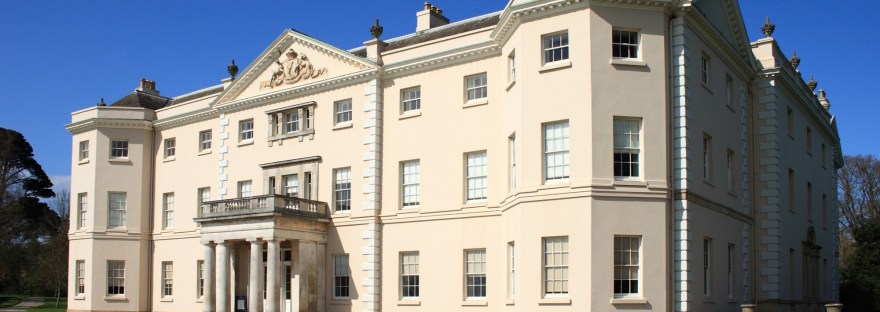
The next stamp in my trusty National Trust passport was achieved at Saltram, a beautiful Georgian mansion overlooking the River Plym in Devon.
I’m embarrassed to admit that the first thing I did was fail to find the entrance to the property. In my defence, it was not well labelled. This hiccup also allowed me to fully explore the beautiful exterior of the building once described by the architectural critic Pevsner to be ‘the most impressive country house in Devon.’ 1
Entrance eventually found, I was greeted by a wonderfully friendly National Trust volunteer who was both passionate and knowledgeable about the house. When I asked an awkward question about a painting I’d spotted she was happy to make an educated guess for me before we Googled it, just to be sure.
Originally a modest Tudor house, surrounded by acres of land and salt marsh, Saltram was owned by James Bagg II, who was Head of Customs. A man notorious for his dishonesty he earnt the nickname ‘the bottomless bag’. He spent his wealth modifying the house at Saltram and built a tower so that he could watch ships as they arrived in the harbour. His corrupt dealings were eventually exposed in Star Chamber during the 1630s. He died in debt and disgrace. The family fortunes never recovered.
After the Civil War the house changed hands several times before being purchased by the Parker family in 1712. It was in the 1740’s that John Parker I, 1st Lord Boringdon, began to make changes to Saltram. The old house was remodelled and given the beautiful Georgian facade that can be seen today. The landscape surrounding the property was also altered; with the addition of gardens.
His son, John Parker II continued the development with the extension of the stable complex and coach house, an orangery, and a ‘castle’ (which looks like it’s been shrunk in the wash). He filled the house with artwork by Joshua Reynolds, much of which can still be seen by visitors today, and made Saltram one of the grandest houses in Devon. Even King George III once stayed there. Successive generations of the Parker family added to Saltram, putting their own stamp on the property.
The estate fell into decline after WWII and was eventually given away in lieu of death duties before being taken on by the National Trust.
Saltram has a rich history and a fascinating interior. My favourite section of the house was the Tudor courtyard. This is where the kitchen is situated and I could imagine some elaborate and delicious meals being prepared here. Part of the early house, this truly feels like the heart of the home and its originality is beautiful.
- Pevsner, Nikolaus & Cherry, Bridget, The Buildings of England: Devon, (London, 2004), 710. ↩︎


